Blog

  • Social Media for Chiropractors: 12 Post Ideas That Bring In New Patients

    You explain the same things to patients every single day.

    What an adjustment feels like, why that desk is wrecking their neck, how many visits they might need.

    That’s your content plan, and you already have it.

    The hard part is turning it into posts people actually stop scrolling for, and doing it within your College’s rules.

    Here are 12 post ideas that work for chiropractic clinics, the rules to keep in mind, and how to turn followers into booked appointments.

    Answer the questions people are too shy to ask

    Plenty of people put off seeing a chiropractor because they don’t know what to expect.

    Content that answers those questions removes the biggest barrier to booking.

    1. “Does it hurt?” A calm, honest explainer of what an adjustment feels like, and what that popping sound actually is.
    2. Your first visit, start to finish. Intake, assessment and what you’ll talk about before any treatment happens.
    3. What to wear. A small, practical post that saves new patients an awkward moment.
    4. “Do I need a referral?” Explain that patients can book with you directly, and suggest they check whether their benefits plan asks for anything.
    5. How payment works. Whether you direct bill, and a nudge to check what their extended health plan covers.

    Teach something useful in under a minute

    Short, practical tips are the posts people save and send to a friend.

    Keep them general, because social media is the place for education, not personal clinical advice.

    • Desk setup. Screen height and chair tweaks for people working from home or a downtown office.
    • Snow shovelling. Technique and warm-up tips, posted before the first big storm.
    • Carrying the load. Backpacks, diaper bags and grocery runs.
    • Long drives. Simple posture resets for the commute or a weekend trip up north.

    End each one with an easy next step, like letting people know they can book an assessment if it sounds familiar.

    Let people meet you before they walk in

    • Meet the team. Who each chiropractor and staff member is, and what they love about the work.
    • A walk through the clinic. The front desk, the treatment rooms, even where to park.
    • Behind the scenes. Setting up for the day, a team lunch, the clinic dog if you have one.

    People book with someone they feel they already know.

    These posts do that quietly, week after week.

    Know your College’s rules before you post

    Chiropractors in Ontario follow the College of Chiropractors of Ontario’s Standard of Practice S-016, Communication to the Public, and it applies to social media.

    You’re responsible for anything posted on your behalf, including by an employee or an agency.

    These are the points that matter most for day-to-day posting:

    • No guarantees. Don’t promise results or suggest care is sure to work.
    • No comparisons. Don’t compare your practice, qualifications or techniques with other chiropractors or providers, or claim a technique is superior.
    • Education, not advice. General health information is fine, but don’t give clinical advice or a diagnosis in posts or comments.
    • Testimonials have strict conditions. Testimonials about your own clinic may only appear on your website, need written consent, and need a note that results may vary.
    • Protect privacy. Never identify a patient, even through a combination of details, and keep patient conversations in secure private messages.

    Read the full standard on the College’s website before you rely on this summary.

    This article is general information, not legal advice.

    Turn followers into booked appointments

    Likes are nice, but bookings keep the lights on.

    • Make booking easy. Put your booking link in your bio and mention it in your posts.
    • Reply quickly. Answer general questions in the comments, and move anything personal to a private message.
    • Pin your best posts. Keep your three most helpful posts at the top of your profile for new visitors.
    • Stay consistent. Two or three posts a week, every week, beats a busy month followed by silence.

    Want it handled for you?

    We’re a Toronto-based team that manages social media only for healthcare practitioners.

    We plan your calendar, write your posts and schedule everything, with your College’s standards in mind.

    See how we handle social media for chiropractors, compare our packages, or book a free 15-minute discovery call.
  • Leveraging Social Media for Naturopathic Doctors

    Naturopathic doctors have a unique opportunity to broaden their reach and connect with patients through social media. By embracing platforms such as Instagram, Facebook, Twitter, and LinkedIn, naturopaths can share their holistic approach to health and wellness, offering insights into natural remedies, lifestyle changes, and preventive care that speak directly to the health-conscious individual.

    Why Social Media Matters for Naturopathic Doctors

    Social media isn’t just about staying relevant; it’s a powerful tool for education and engagement. For naturopathic practitioners, it offers a platform to demystify alternative medicine, showcase success stories, and highlight the benefits of a natural approach to healthcare. Through thoughtful content and active engagement, naturopaths can build a community of followers who are interested in natural health solutions, thereby increasing their patient base and enhancing their practice’s reputation.

    Creating Impactful Content

    The key to a successful social media presence lies in the content. For naturopathic doctors, this could mean informative posts about the benefits of certain herbs, tips for maintaining a balanced diet, or simple lifestyle adjustments to improve well-being. Sharing success stories or testimonials can also be incredibly powerful, providing real-life examples of how naturopathic medicine has made a difference in patients’ lives.

    Specializing in Health-Focused Social Media

    For those looking to take their social media to the next level, specializing in health-focused content is a strategic move. This involves not just sharing general wellness tips, but also diving deep into topics that resonate with your audience. Whether it’s a series on gut health, the importance of sleep, or managing stress naturally, providing specialized content can position you as a thought leader in your field.

    Moreover, engaging with your audience through Q&A sessions, live videos, and interactive posts can foster a sense of community and trust. It’s not just about broadcasting information; it’s about creating a two-way conversation that values the questions and concerns of your followers.

    Outsourcing Social Media Services

    Wellness Wave Marketing provides specialized social media marketing services tailored for healthcare professionals, including naturopathic doctors. Our approach is unique for each client, focusing on creating engaging content that resonates with the target audience while adhering to healthcare standards. We offer various packages, including classic, elite, and premium, to cater to different needs and budgets. Additionally, they have a “Done-For-You” content pack for healthcare professionals looking to enhance their social media presence without the hassle of constant content creation. Wellness Wave emphasizes the importance of a customized strategy that reflects the unique character of each healthcare practice, aiming to build a strong online community and increase visibility.

    Conclusion

    For naturopathic doctors, social media is more than a marketing tool; it’s a platform for education, engagement, and empowerment. By sharing their expertise and passion for natural health, they can not only grow their practice but also contribute to a healthier, more informed society. With the right strategy, content, and engagement, the path to success on social media can be both rewarding and impactful.

    Want help with this? See how we handle social media for naturopathic doctors.

  • Building a Strong and Engaged Community as a Healthcare Practitioner

    In today’s digital age, healthcare practitioners have a unique opportunity to connect and engage with their patients and peers through community building. By fostering a sense of belonging and trust, healthcare professionals can create a supportive network that not only benefits their patients but also helps establish their expertise in the field. In this article, we will explore effective strategies to build a strong and engaged community as a healthcare practitioner, empowering you to enhance patient care, expand your reach, and establish lasting relationships.

    1. Define Your Purpose and Values:

    To build a community, it’s crucial to have a clear understanding of your purpose and values as a healthcare practitioner. Identify your mission, goals, and the values that guide your practice. Communicate these principles authentically and consistently across your online platforms, demonstrating your dedication to patient care and building trust.

    2. Create an Engaging Online Presence:

    Establishing a strong online presence is essential in today’s digital landscape. Develop a professional website that reflects your expertise and showcases your services. Optimize your website with relevant keywords such as your specialty, location, and services to improve search engine visibility. Regularly update your blog with informative and educational content that addresses common health concerns, utilizing keywords strategically to attract organic traffic.

    3. Leverage Social Media Platforms:

    Social media platforms are powerful tools for community building. Identify the platforms where your target audience is most active and create professional profiles on those platforms. Share valuable content, including health tips, industry news, and patient success stories, while incorporating relevant keywords. Engage with your audience by responding to comments and messages promptly, fostering meaningful connections and demonstrating your commitment to patient care.

    4. Establish Thought Leadership:

    Positioning yourself as a thought leader in your field enhances your credibility and attracts a dedicated community. Publish insightful articles on reputable healthcare websites or industry publications, focusing on topics of interest to your target audience. Incorporate keywords related to your expertise and location to improve search engine rankings. Participate in professional conferences, webinars, or podcasts as a guest speaker, showcasing your knowledge and expertise to a wider audience.

    5. Foster Patient Engagement and Education:

    Educating and empowering your patients is crucial for building a strong community. Offer informative resources, such as downloadable guides, e-books, or video tutorials, on your website. Use email newsletters to provide valuable health tips, updates on medical advancements, and information about upcoming events or workshops. Encourage patient feedback and testimonials, showcasing their success stories and building social proof.

    6. Collaborate with Peers and Local Organizations:

    Collaboration is a powerful way to expand your reach and build a diverse community. Connect with other healthcare practitioners and local organizations to exchange ideas, share resources, and collaborate on projects. Consider hosting joint events, workshops, or webinars to offer comprehensive care and tap into each other’s networks.

    7. Engage Offline:

    While digital platforms are vital, don’t overlook the importance of offline engagement. Participate in local community events, health fairs, or support groups to connect with individuals face-to-face. These personal interactions can foster trust and strengthen relationships within your community.

    Building a strong and engaged community as a healthcare practitioner requires dedication, authenticity, and a patient-centric approach. By defining your purpose, leveraging online platforms, establishing thought leadership, fostering patient engagement, collaborating with peers, and engaging offline, you can create a supportive community that enhances patient care, expands your reach, and solidifies your position as a trusted healthcare professional. Embrace these strategies, and watch your community thrive, providing a valuable support system for both you and your patients.

    References:

    Habibi, M. R., Laroche, M., & Richard, M. O. (2014). The roles of brand community and community engagement in building brand trust on social media. Computers in human behavior, 37, 152-161.

  • Marketing for Naturopathic Doctors: A Practical 6-Step Plan

    Marketing for Naturopathic Doctors: A Practical 6-Step Plan

    Most people who book with a naturopathic doctor don’t do it on a whim.

    They read, they compare, they follow a few NDs quietly for weeks, and then they book with the one who already feels familiar.

    Marketing an ND practice is really about being that familiar, trusted name.

    You don’t need a huge budget or a viral video to get there.

    You need a few simple things done consistently, and you need to do them within the College’s advertising rules.

    Here’s a practical plan.

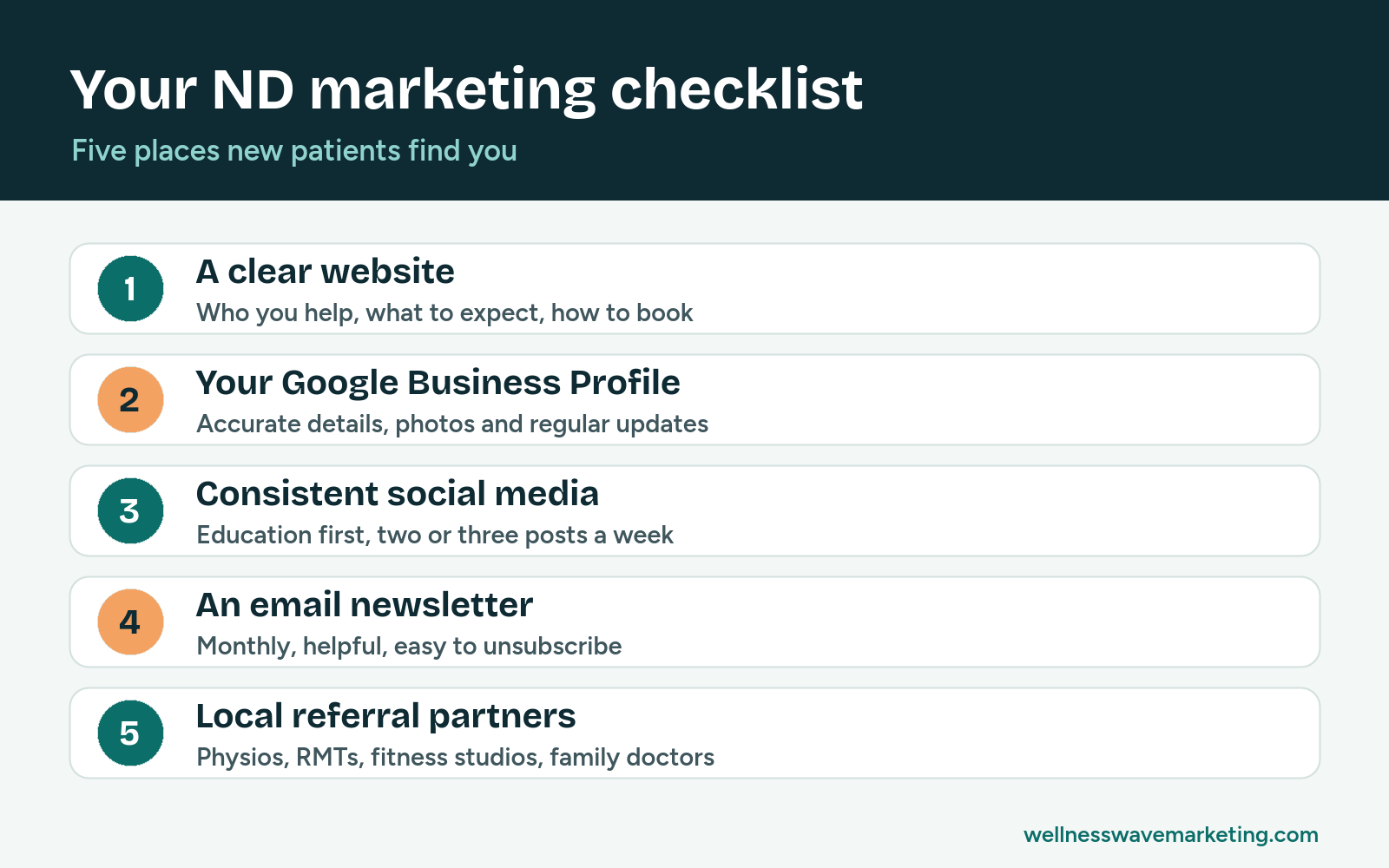
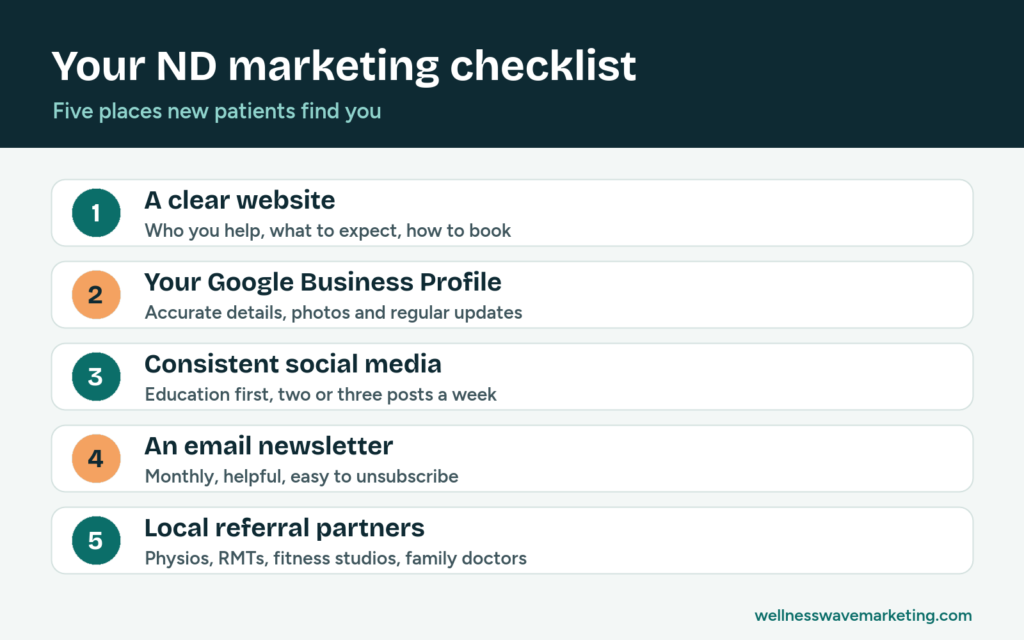
    A five-part marketing checklist for naturopathic doctors

    1. Make it obvious who you help

    “I help people feel their best” describes almost every ND in Toronto.

    The practices that grow are clear about who they love working with.

    Maybe that’s digestive health, fertility, perimenopause, athletes or busy parents.

    Pick the areas you focus on and say so everywhere: your website, your social bios and your Google Business Profile.

    A quick test: could a stranger tell, in five seconds on your homepage, whether you’re the right ND for them?

    2. Get your website doing its job

    Your website is where interested people decide whether to book, so it needs to answer their questions before they ask.

    • Who you help. Your focus areas, in plain language.
    • What a first visit looks like. How long it takes, what you’ll talk about and what to bring.
    • Fees and coverage. Your fees, and a note that many extended health plans cover naturopathic visits, so patients should check theirs.
    • How to book. One clear button on every page.
    • A little about you. Your training, your approach and a real photo.

    3. Show up on Google

    When someone searches “naturopath near me”, the map results come from Google Business Profiles.

    An accurate, active profile is one of the cheapest ways to get found locally.

    • Fill in everything. Hours, services, website, booking link and a clear description.
    • Add real photos. Your clinic, your treatment room and you.
    • Post updates. A short tip or clinic update every week or two keeps the profile active.
    • Keep details consistent. Your name, address and phone number should match your website exactly.

    4. Post on social media without burning out

    Social media is where people get to know you before they book.

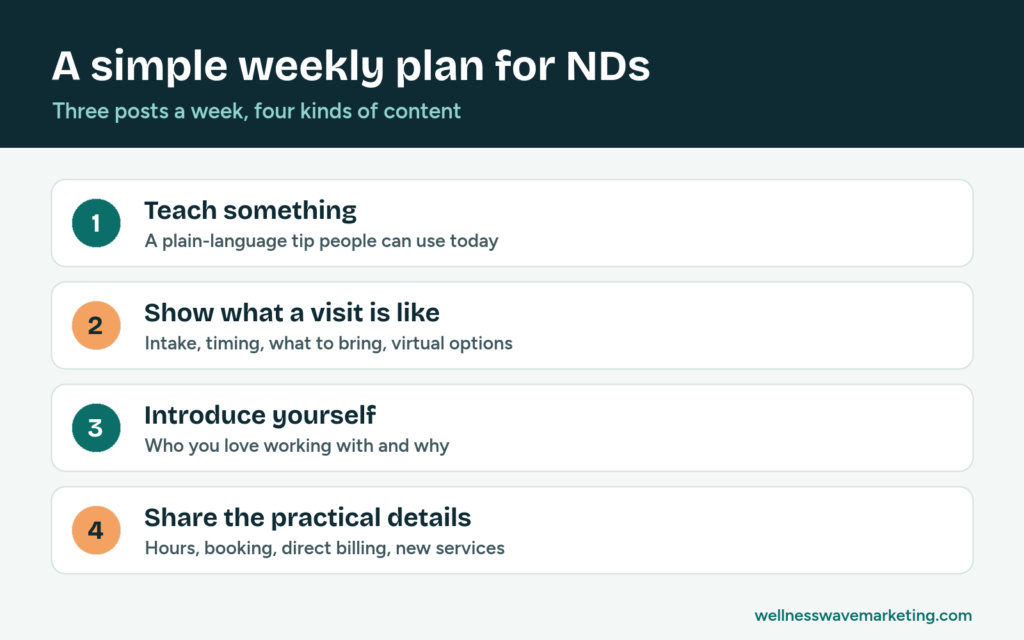
    Three posts a week is plenty, as long as you keep it up.

    Rotate through four types of content so you never stare at a blank screen.

    A simple weekly social media content plan for naturopathic doctors

    A few post ideas to get you started:

    • “What happens at a first ND appointment?” Walk through intake, timing and what to bring.
    • A seasonal tip. Sleep and routines during Toronto’s dark winter months, or easy summer meal ideas.
    • “Does my insurance cover naturopathy?” Explain how to check their extended health plan.
    • Why you became an ND. People connect with people.
    • Myth or fact. Clear up a common misunderstanding in your focus area, carefully and without overpromising.

    For more ideas, read our guide to social media for naturopathic doctors.

    5. Stay in touch with email

    Most people who follow you aren’t ready to book today.

    A short monthly email keeps you in mind until they are.

    • Keep it useful. One helpful idea, one clinic update, one booking link.
    • Ask first. Only email people who signed up, and make unsubscribing easy, as Canada’s anti-spam law requires.
    • Never single anyone out. Send the same newsletter to your whole list, not targeted pitches to individuals.

    6. Build local referral partners

    Some of your best new patients will come from other practitioners.

    Get to know the people your patients already see.

    • Physiotherapists, chiropractors and registered massage therapists nearby.
    • Fitness studios, yoga studios and running clubs.
    • Family doctors, midwives and doulas, if it fits your focus.
    • Pharmacies and health food stores in your neighbourhood.

    A friendly coffee and an offer to share helpful resources goes a long way.

    Know the College’s advertising rules

    NDs in Ontario follow the College of Naturopaths of Ontario’s advertising standard, and it applies to your website and social media.

    You’re responsible for advertising about your practice, even when someone else creates it.

    These points matter most for everyday marketing:

    • Testimonials. The College’s advertising standard has not allowed patient testimonials about your practice, and the College has been reviewing this, so check its latest guidance before using any.
    • No promises. Don’t guarantee results or suggest you can cure a condition.
    • No comparisons. Avoid saying you’re better than other practitioners, or using words like “the best”.
    • Keep it accurate. Everything you say should be true and verifiable.
    • Don’t play on fears. Educate rather than alarm.

    Read the College’s current standard before you rely on this summary.

    This article is general information, not legal advice.

    Want help putting this into practice?

    We’re a Toronto-based team that manages social media only for healthcare practitioners.

    We plan your content calendar, write your posts and schedule everything, with the College’s standards in mind.

    See how we handle social media for naturopathic doctors, read our guide on how to find clients as a naturopathic doctor, compare our packages, or book a free 15-minute discovery call.